

service hotline:
+86 18929311368
+86 18929311368
Overview of planetary gear transmission
1, planetary gear definition and classification
In the plane gear train, it is divided into two categories according to whether the relative position of the geometric axis of each gear changes when the gear train is running, one is the fixed axis gear train and the other is the planetary gear train.
When a planetary gear train is running, if at least one of the gears that make up the gear train has a geometric axis that is not fixed and rotates around the geometric axis of other gears, then the gear train has at least one gear that does planetary motion, which, as the name implies, does both rotation and revolution.
According to the number of degrees of freedom, planetary gear transmission can be divided into simple planetary gear transmission and differential planetary gear transmission. The differential planetary gear transmission has a complex structure and can achieve a larger speed ratio, but it is rarely used in the new energy automobile industry, so this paper only discusses the application of simple planetary gear.
According to the gear meshing mode of planetary gear transmission classification, it can be mainly divided into NGW, NW, NN, ZUWGN, NGWN and other types, but at present, more NGW type is used in new energy vehicle transmission, NW type also has a small number of applications, NGW type and NW type main principles are as follows:
2, the characteristics of planetary gear transmission
Compared with fixed shaft transmission, planetary gear transmission has many unique characteristics:
1) Small size, light weight, compact structure, large torque transmission. Due to its reasonable application of internal meshing gear pairs, so the structure is relatively compact, and because of its multiple planetary wheels around the center wheel in common load sharing, the formation of power shunt, so that each gear is subject to less load, so the volume of the gear can be small. In addition, the structure makes full use of the tolerable volume of the internal meshing gear itself, further reduces its profile size, makes it small in size and light in weight, and improves the load-carrying capacity of the power shunt structure. According to the relevant literature, under the same transmission load, the outer size and weight of the planetary gear transmission is about 1/2 to 1/5 of the ordinary fixed shaft gear.
2) Input and output coaxial. Because of its structural characteristics, the planetary gear transmission can realize the input and output coaxial, that is, the output shaft and the input shaft are on the same axis, so that the power transmission does not change the position of the power axis, which is conducive to reducing the space occupied by the entire system.
3) Easy to achieve small volume speed change. Because the planetary gear has three basic components, such as the sun wheel, the inner gear ring, and the planetary frame, fixing one of them, the speed ratio is determined, that is, the same set of gear train, and three different speed ratios can be achieved without adding other gears. As shown in the following table:
Of course, in the above cases, the fixed part can be loosened and the input part or the output part is fixed together to form a speed ratio of 1.
4) High transmission efficiency. Due to the symmetry of the planetary gear transmission structure, that is, it has several evenly distributed planetary wheels, so that the reaction force acting on the center wheel and the rotating bearing can balance each other, which is conducive to improving the transmission efficiency, in the case of proper transmission type selection and reasonable structural arrangement, the efficiency value can reach 0.97~0.99.
5) Large transmission ratio. Can achieve the synthesis and decomposition of motion, as long as the appropriate selection of the type of planetary gear transmission and tooth matching scheme, you can use fewer gears and obtain a large transmission ratio, even if the transmission ratio is large, you can maintain the advantages of compact structure, light weight and small size.
6) Smooth movement, strong resistance to shock and vibration. Due to the use of several planetary wheels with the same structure, evenly distributed around the center wheel, so that the planetary wheel and the inertial force of the planetary frame balance each other, at the same time, the number of teeth involved in meshing increases, the transmission will be relatively stable, strong impact resistance, and more reliable work.
In short, planetary gear transmission has the characteristics of small weight, small size, large speed ratio, large transmission torque and high efficiency. In addition to the above favorable characteristics, the planetary gear will also have the following problems in the application process.
1) The structure is complex. Compared with fixed shaft gear transmission, planetary gear transmission structure is more complex, the increase of planetary frame, planetary wheel, planetary wheel shaft, planetary wheel bearings and other parts, the increase of parts also means the increase of fault points, higher quality control requirements.
2) High heat dissipation requirements. Due to the small size and small heat dissipation area, it is necessary to design reasonable heat dissipation to avoid too high oil temperature, at the same time, the rotation of the planetary frame or the rotation of the internal gear, due to the role of centrifugal force, the gear oil is easy to form an oil ring in the circular direction, so that the lubricating oil in the center of the sun wheel is reduced, affecting the lubrication of the sun wheel, and the addition of too much lubricating oil will make the mixing loss greater. Therefore, this is a contradiction, it is necessary to design the lubrication system of the gear reasonably to ensure the reasonable lubrication of the components and not to make the mixing loss too large.
3) High cost. Because the planetary gear transmission structure is more complex, many parts, assembly is also complex, so its cost is high. Especially its inner gear ring, due to the structural characteristics of the inner gear ring, the gear making process can not use the outer cylindrical gear commonly used high efficiency hobbing and other processes, can only use gear shaper, gear drawing or gear turning and other processes, especially the internal bevel gear, the use of bevel slotting requires special spiral guide rail or CNC gear shaper machine and efficiency is relatively low, the use of gear drawing or gear early equipment and tooling investment are very high. Its cost is much higher than that of ordinary external cylindrical gear.
4)NVH is difficult. Due to the characteristics of the inner gear ring, it cannot achieve a higher precision by grinding and other processes for the final treatment of the gear tooth surface, nor can it micro-modify the gear tooth surface through the gear, so that the gear mesh cannot reach an ideal state.
It is difficult to improve the NVH level.
In SUMMARY: Due to the structural characteristics of planetary gear transmission, there are its unique advantages and disadvantages, there is no perfect thing in the world, anything has two sides, planetary gear is the same, the application of new energy is also based on its advantages and disadvantages combined with the specific needs of the model or product to make full use of its advantages, and do a balance between its advantages and disadvantages, to bring value to the vehicle and customers.
Second, the application of planetary gear transmission in new energy vehicles
At present, the driving form of new energy vehicles, whether commercial vehicles or passenger vehicles, can be roughly divided into centralized drive and distributed drive according to power concentration or distribution.
In the field of new energy vehicles, motors are the main source of power. Since the volume, weight and cost of the motor are proportional to the torque of the motor, the current trend of development is to increase the speed ratio of the assembly in the form of the reducer or transmission, reduce the motor torque, and reduce the motor high-speed, by improving the motor speed to ensure that the power does not change in the case of reducing the volume, weight and cost of the motor. With the need for deceleration or transmission, planetary gear transmission has an application scenario. Therefore, whether it is a distributed drive or a centralized drive, there are scenarios for planetary gear transmission applications, but the requirements are different and the application characteristics are different.
1, the application of passenger cars
(1) Toyota Prius THS system
First generation Toyota Hybrid System (THS)
I, code defined as P111. Single planetary power shunt: the small motor MG1 is connected to the sun wheel, the engine is connected to the planetary frame, the large motor MG2 is connected to the gear ring, and the gear ring output. Chain drive: Compact structure, no axial impact, two-stage deceleration, differential connecting the left and right wheels.
As can be seen in the figure above, a mechanical device is separated between motor 1(MG1) and motor 2(MG2), called a Power Split device
Device)PSD. This is also the single-planet platoon power shunt system that has been used by all two generations of Toyota hybrid electric drive systems. The engine, motor 1 and motor 2 are actually coaxial connected by a power shunt device. The power is redistributed by the power shunt device and then transmitted to the wheels by motor 2. In fact, the power shunt device is a set of planetary gears. Planetary gear by the Sun wheel Sun
Gear(abbreviation S), Planetary Carrier(abbreviation C), inner tooth Ring Gear(abbreviation R).
The following is the Toyota THS system connection diagram. It can be seen that the engine is connected to the planetary frame, the motor 1 is connected to the sun wheel, and the motor 2 is connected to the tooth ring and serves as the output shaft.
MG1 motor, MG2 motor and planetary row are arranged on the same axis; The engine output shaft is connected with the planetary frame, and the mechanical pump drive shaft is connected inside the shaft at the same time, that is, when the engine is running, the mechanical pump works, and the mechanical pump is arranged at the back end of the transmission; The MG1 motor is connected to the sun wheel through an internal spline, which is located between the planetary bank and the engine; The MG2 motor is connected with the gear ring through the external spline, which is located on the other side of the planetary row;
In 2003, Toyota launched the second generation of Prius models, the total number of the hybrid power to become THS- II, the set of hybrid system code defined as P112, P112 and P111 the basic structure of the same, the deceleration mechanism part is still using chain drive, the rear two parallel shaft type deceleration.
In 2008, Toyota launched the third generation of the Prius, which is equipped with a hybrid total of THS- II. The hybrid system is codenamed P410.
Double planetary row structure, one as the power distribution unit, one as the MG2 deceleration unit; Dual motor coaxial arrangement, MG2 for the motor, MG1 for the generator; Cancel chain drive, use parallel shaft type two-stage gear reduction;
Between the left box and the right box of the P410 is a shafting structure, which mainly contains a power distribution planetary row, a MG2 decelerating planetary row and a secondary decelerating mechanism. The two planetary rows are arranged coaxial, the power distribution planetary rows and the MG2 deceleration planetary rows share the same gear ring, and the gear ring is also used as the output.
Power distribution planetary row: Sun wheel is connected with MG1; The planetary frame is connected to the engine; Gear ring output.
MG2 decelerating planetary row: Solar wheel is connected with MG2; The planetary frame is fixed with the box; Gear ring output.
In December 2015, the fourth-generation Prius was introduced with the THS II (P610) hybrid powertrain. The power shunt planetary platoon is the same as previous generations, dividing the power of the engine between the drive power of the whole vehicle and the generator.
The first three generations of the Prius (Toyota hybrid system) all use the engine and motor MG1 on the same side of the power distribution planetary gear set, and the motor MG2 on the other side, all three are coaxial. The fourth-generation Prius hybrid transmission P610, motor MG1(sun wheel) and engine (planetary frame) are still coaxial, but on both sides of the planetary gear set. The motor MG2 is no longer coaxial, decelerated by a reverse driven gear and combined with the teeth of the planetary gear set.
In the P410 structure, the power shunting planetary bank and the reduction planetary bank share the same gear ring, and the support bearings for the gear ring are mounted on the outside of the gear ring. In the new P610, the gear ring engages only one set of planetary gears, so the bearings are adjusted inside the gear ring and supported on the housing, thus contributing to the reduction in size. A two-stage parallel deceleration mechanism is used to replace the P410 protoplanetary deceleration mechanism, reducing the point of engagement and thereby reducing the mechanical loss.
(2)Audi e-tron
The front axle and the rear axle are each equipped with a motor, which transmits the driving force to the wheels through their respective retarders.
Torque transfer on the front axle is achieved by arranging the input and output axes in a parallel manner. In the rear axle is through the coaxial structure to transfer the torque.
A single-stage reducer with two-stage reduction is responsible for reducing the speed on the front and rear axle, thereby increasing the torque.
A planetary geared light structure differential is used in these two reduction boxes to achieve speed compensation between two wheels on the same axle. The reducer has no idling position, that is, there is always power transfer between the wheel and the motor rotor shaft.
Front axle single-stage reducer - OMA
It has a two-stage reduction ratio and the latest planetary gear type light structure differential. The torque conversion is divided into two stages: the first reduction stage is transmitted from the sun wheel shaft to the planet gear and planet carrier using a simple planetary gear pair; The second reduction stage uses a cylindrical gear mechanism to transfer torque from the planetary frame to the differential.
One of the characteristics of the planetary gear type light structure differential is that it requires very little axial space.
The planetary frame in the first reduction ratio can be locked by the parking lock, so that the parking lock gear is connected to the planetary frame.
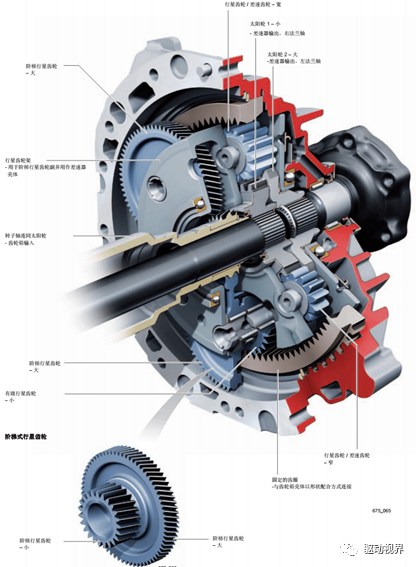
Planetary gear structure differential
For the first time, Audi uses SCHAEFFLER's planetary gear structure differential. What makes this structure unique is that it is suitable for Audi
Electric drive mechanism of e-tron. The axial space is small but the torque can be transferred greatly; The weight is significantly reduced (compared to a traditional bevel gear differential).
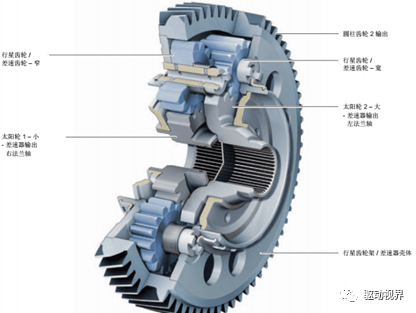
This is an open cylindrical gear differential that distributes the input torque equally between the two outputs.
This driving force is transmitted to the differential housing via cylindrical gear 2. The differential housing is used as a planetary frame, which in turn transfers equal torque to the planetary gears. The wide and narrow planet gears mesh with each other and act as differential gears, distributing torque across the two sun wheels and taking care of the required wheel speed compensation when turning. The narrow differential gear meshes with the small sun wheel 1; The wide differential gear engages with the sun wheel 2.
One of the reuse features of this light-structure differential with row gear is that the width of the structure is very small. Specifically, this is achieved by using two solar wheels of different sizes. In order to transmit the torque equally to both sides, the geometry of the gears is designed in such a way that the two solar wheels have the same number of teeth. Because the tooth roots of the small sun wheel are relatively narrow, the gear is widened. To be able to bear the load.
2.3 Rear axle single-stage reducer - OMB
With coaxial structure double reduction ratio and planetary gear structure differential. This differential is essentially the same as OMA's planetary gear differential. This two-stage torque conversion is achieved using the tower wheel. The first reduction stage is a large cylindrical gear passed from the sun wheel to the tower wheel. The second reduction stage is achieved through the pinion of the tower wheel (which is supported by a fixed ring of teeth and drives the planetary frame). The torque is transmitted directly through the planetary frame to the planetary gear type light structure differential.
The planetary frame is divided into two planes: meshing with the tower wheel in the first plane; The second plane engages the planetary gears (wide and narrow) of the differential, and thus forms the differential housing.
(3) Honda I-MMD (Intelligent Multi-Mode Drive)
The I-MMD System is compatible with Toyota's second-generation Hybrid THS-II(Toyota Hybrid System)
II) system (hybrid, using a planetary gear structure as a power coupling device between the engine and the dual motor), the I-MMD system uses an overrunning clutch to achieve automatic switching of the engine to drive the generator or drive the wheels.
The 2016 Accord hybrid uses an electric continuously variable transmission E-CVT, which has no traditional variable speed structure such as torque converter, gear or belt wheel, but retains the main reducer and differential assembly. The E-CVT integrates a generator, drive motor, torsional shock absorber, overrunning clutch, overrunning clutch gear, four parallel shafts and gears.
The I-MMD system of the 2016 Accord Hybrid uses the overreach clutch, a hydraulically actuated clutch (wet multi-disc) located at the end of the input shaft. The power transfer path is changed by overstepping the clutch, thus enabling the power of the engine to be switched between driving the generator and driving the wheels.
When the overrunning clutch is not working (separated), if the engine is running, the engine power will be generated by twisting the shock absorber → input shaft → input shaft gear → generator shaft gear → generator shaft → generator, so that the engine drives the generator to generate electricity. When the overrunning clutch is working (engaging) and the engine is running, the engine power will be transferred to the front wheel (drive wheel) by twisting the shock absorber → input shaft → overrunning clutch → overrunning gear → countershaft gear → countershaft → main reducer drive gear → main reducer driven gear → differential → half shaft → front wheel. In addition, when overrunning the clutch (engaging) and the engine is running, the engine will also drive the generator to rotate (idling).
(4) Jaguar I-PACE
Most electric vehicles have an electric motor positioned on the drive shaft and drive the wheels through a bevel gear connection, while the I-Pace uses a planetary gear set, which saves space and improves efficiency to a certain extent.
The reduction gear is a dual-planetary structure, similar to the rear-drive reduction gear of Audi e-tron. The planetary frame in this planetary structure also integrates the structural function of the differential housing. The difference is that the differential of the I-PACE belongs to the bevel gear differential, and the Y-dimension is larger than that of the e-tron.
The reduction ratio of the single speed planetary gear set is 9:1, and the arrangement of the slip clutch takes into account the differential change. So, no bulky transmissions or differentials. The front and rear axles each integrate a lightweight permanent magnet motor, which is coaxially connected to the single-speed planetary gearset reducer and the open differential (with a brake-based torque vector instead of a locking differential) for maximum compactness, distributing torque to all four wheels instantly and precisely as the I-Pace constantly adjusts its front and rear balance to match road conditions. The output shaft of the motor is directly driven by a coaxial planetary row used to reduce the speed. The advantage of the coaxial design is to increase the integration of the electric drive system and reduce the system weight as much as possible.
(5) A 2-speed transmission application
Due to the characteristics of planetary gear transmission, a set of planetary gears can easily realize the compact structure and small volume of 2-speed transmission. Its principle is shown in the following figure.
It adopts a set of NGW type planetary gear, which has two shifting components: a clutch C1, a brake B1; When C1 is separated and B1 is combined, it is an NGW type reducer with a speed ratio of i=Zb/Za+1; When C1 is combined, the separation speed ratio of B1 is 1, and when both B1 and C1 are separated, it is neutral.
A two-speed transmission is realized in a small volume, which requires two pistons, a clutch piston and a brake piston. If there is no need for neutral gear, only 1 and 2 gears, then only one piston is needed, and one piston controls the clutch and brake at the same time. The two states of piston push-out and non-push-out correspond to two gear positions respectively. For example, there is no oil pressure in the piston, when the piston is not pushed out, C1 is normally closed and B1 is normally open. The slow separation of C1 and the combination of B1, this structure can theoretically reduce a part of the cost, because the brake and the clutch combination or separation process is carried out together, how to mechanically ensure the separation and combination of time for the early calibration requirements are higher.
2. Application in commercial vehicles
(1) Bus ticket reduction application
At present, the mainstream power form of electric buses is direct motor drive, that is, through a large torque motor through a drive shaft and the rear axle connected, the main problem of this structure is large volume, heavy weight, high cost. Through the application of planetary gear reducer, the use of its input and output coaxial, compact structure, large transmission torque and other characteristics, only a single stage reducer can better achieve the goal of reducing volume, reducing weight, reducing cost. The installation layout of the original direct drive is not affected. The schematic diagram of its principle is as follows:
After the direct drive large motor is changed to the planetary single-stage deceleration program, the main parameters are compared in the following table:
Table 2-1 Direct drive motor and single-stage planetary gear reducer scheme
It can be seen from the comparison of the above table that the single-stage planetary gear reducer can greatly reduce the weight and cost of the motor, although the increase of the single-stage planetary gear reducer increases the weight and cost of the part, but the system weight is reduced by 100kg, and the cost is reduced by about 4000 yuan.
If the reducer adopts parallel shaft fixed shaft gear transmission, due to the large input torque and high speed of the reducer, the bearing of the input shaft is difficult to choose, and the coaxial output structure is more complicated. The use of planetary gear transmission is a better choice, making full use of the input and output coaxial, compact structure, large transmission torque characteristics.
(2) Coaxial motor bridge application
At present, the integrated motor bridge mainly has parallel axis scheme and coaxial scheme. Compared with the parallel axis scheme, the coaxial scheme has the characteristics of high integration, small volume, small space and light weight. At present, the reducer of the coaxial integrated bridge has parallel shaft fixed shaft gear transmission and planetary gear transmission schemes, planetary gear transmission is smaller and more compact than parallel shaft fixed shaft gear transmission, and the transmission torque is larger, while because the planetary gear radial force can cancel each other, the high-speed large bearing is easier to choose.
In the coaxial bridge, because the left and right half shafts have to pass through the motor shaft and the input shaft of the reducer, the motor shaft needs to be made into a hollow shaft. When the output torque of the whole bridge is larger, the diameter of the shaft will increase, and the diameter of the motor shaft will also increase. After the motor shaft is larger, the bearing of the motor and the input shaft will also increase. When the bearing diameter becomes larger, it is necessary to use small rollers to meet the requirements of high speed. If the shafting system with parallel shaft fixed shaft and no symmetrical shitter arrangement structure is used, the bearing of the input shaft will be a bottleneck, that is, the bearing inner diameter is required to be large, to meet the requirements of high speed, bearing radial force and other capabilities, such bearings are difficult to choose, and the use of planetary gear transmission is due to the radial force counteracting each other. There is no requirement of radial bearing capacity, so that the bearing can better meet the requirements.
If the coaxial bridge application model is larger, the required torque is larger, the need for a higher speed ratio, the planetary gear transmission can meet the requirements better, through the use of two-stage planetary gear or NW type planetary gear can be easier to achieve a large speed ratio and maintain a compact volume, and the use of fixed shaft gear transmission is more difficult to meet the requirements of large speed ratio in a smaller volume.
NW type compared to the two-stage planetary gear transmission only uses one inner gear ring, the cost of the inner gear ring will be lower, but the NW type planetary wheel needs to use the tower wheel structure, and the gear is a problem to test the production process.
(3) Applications on distributed drivers
Distributed drive drive is the power distribution arrangement, a car may have more than 2 power, wheel drive as a member of the distributed drive, due to its power system arranged at the wheel edge, space is limited, the volume and weight of the drive system has high requirements, based on this demand, combined with the planetary gear transmission small volume, light weight, compact structure, large torque transmission characteristics, It plays a big role in the wheel-driven stage.
In the wheel drive system, due to its speed ratio is larger, generally use multi-stage gear transmission, primary speed is high, torque is small, secondary torque is large and low speed, based on this characteristic, the wheel drive will generally use a parallel shaft gear transmission + two-stage planetary gear transmission transmission system, in order to make full use of space, the planetary gear transmission is arranged in the center hole of the rim. As a wheel reducer, make full use of its limited wheel space.
As shown in the figure above, the wheel reducer mainly consists of solar wheel shaft, planetary wheel, wheel reduction shell, inner gear ring, gear ring bracket and so on. The wheel reduction shell is integrated with the planetary frame, and the planetary wheel shaft is a cantilever structure, which effectively reduces the volume of the wheel reducer.
Because the planetary wheel reducer is arranged in the center hole of the rim, its outside diameter is limited by the size of the center hole of the rim, so the inner gear ring can not be too large. At the same time, the sun wheel shaft should pass the torque of the primary reducer to the wheel edge, the role of its half shaft, so the diameter of its half shaft can not be too small, that is to say, the diameter of the sun wheel can not be too small, and the speed ratio of the wheel edge planetary reducer is directly related to the size of the inner gear ring and the sun wheel, under a certain torque, the optional speed ratio has a range, At present, the known ZF does a relatively large 5.818, and achieves a large speed ratio in a small volume, making full use of the advantages of planetary gear transmission.
ZF
AVE130's first-stage gear reducer, its official introduction material will be called the power shunt planetary gear transmission structure, although its structure is a power shunt fixed shaft gear transmission, not a strict sense of the planetary gear transmission structure, but in fact it is also from the planetary gear structure evolved.
It can be understood as a planetary transmission mechanism of two planetary wheels, the input shaft is the planetary wheel, and the output shaft is the inner gear ring. When power is input from the planetary wheel, the power is directly transmitted to the inner gear ring through the meshing of the planetary wheel and the inner gear ring, and the power is transmitted to the inner gear ring through the sun wheel and then through another planetary wheel, which realizes the power shunt and achieves a large speed ratio in a small space. Also make the input shaft gear, output shaft gear radial force balance.
Iii. Summary
The inherent characteristics of planetary gear transmission have both advantages and disadvantages, only combined with the specific needs of models and products, make full use of its advantages to balance its shortcomings, that is, it can bring value to products and customers, product design does not say which program must be good, and ultimately combined with the characteristics of different programs and product needs to eva1uate and apply, the application will be immediately valuable.
Shenzhen Chuwang Automation Co., LTD
Landline: 0755-27193983
Phone: 18929311368 Mr. Yan
Website: www.szchuwang.com
Add: 1st Floor, Building B1, Youbang Industrial Park, Fourth Industrial Zone, Tianliao Community, Yutang Sub-district, Guangming District, Shenzhen City


 0755-27193983
 QQ
QQ Wechat

 con
con
